Hardware teams are trained to value speed. Faster prototypes, faster board spins, faster sourcing, faster NPI. That pace feels productive. It creates momentum. It also hides risk.
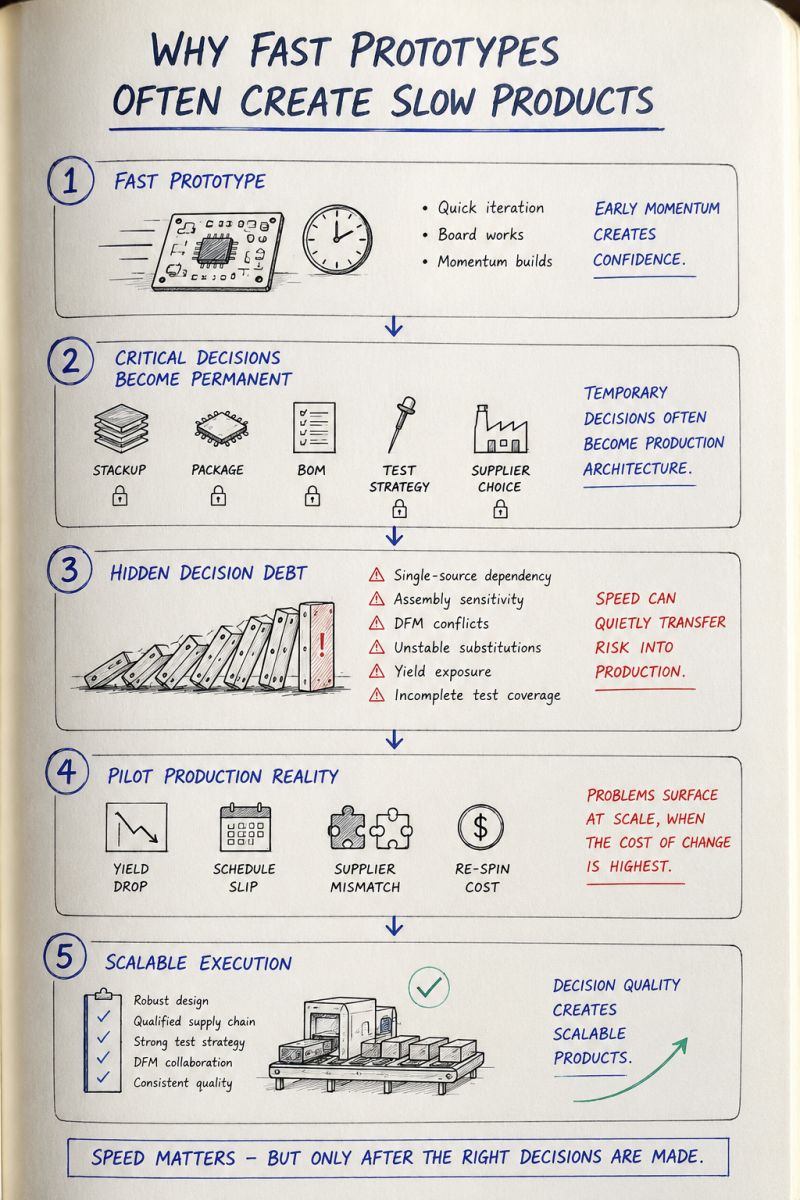
In many programs, the prototype is the easiest part. A board powers up. The demo works. Leadership sees progress. But by then, some of the most important decisions are already locked in: stackup, package choice, test strategy, sourcing assumptions, and assembly constraints.
That is where the real problem begins.
A prototype can succeed while quietly building future failure into the program. A part chosen for availability may become a single-source dependency. A stackup chosen for routing convenience may create manufacturing sensitivity. A test strategy shortened to save time may leave gaps that only appear in pilot production. Even a “temporary” substitution can change assembly behavior and yield.
This is why fast prototypes often create slow products.
The trade-off is not speed versus quality. It is speed now versus decision flexibility later. A rushed decision feels efficient because it removes uncertainty. But in hardware, removing uncertainty too early can be expensive. It can turn into re-spins, yield loss, schedule slips, supplier churn, and field issues that are far harder to fix later.
Prototype builds also hide these mistakes because they are protected by senior engineers, manual intervention, and low-volume tolerance for exceptions. At scale, those protections disappear. The same design now depends on repeatable supply, stable process windows, consistent assembly, and tighter test coverage. What was “good enough” for one successful build can become a production liability.
Experienced teams do not simply move slower. They slow down the decisions that are hard to reverse. They involve manufacturing earlier, treat supply chain as part of architecture, and ask the question that matters most: what happens on the second build, not just the first?
That is the real distinction between teams that prototype well and teams that scale well.
The fastest hardware companies are not always the ones that win. The ones that win are usually the ones that make better decisions early, before speed turns into technical debt.
❗ Have you seen a program that moved quickly in prototype — but slowed dramatically once production started?
#HardwareEngineering #NPI #EMS #PCBDesign #ElectronicsManufacturing

Leave a Reply